
Weekly round up #03

AI and Tech
Mythos / Fable
This is of course the biggest Current Thing in AI. The headlines move too fast for me to make any meaningful contribution to the discussion here, but I recommend the following articles:
- Ethan Mollick on What it feels like to work with Mythos
- Zvi's analysis of the system card
- Zvi's coverage of the USG export controls debacle
Midjourney Medical Scanner
Midjourney (the AI image gen startup) is pivoting to medical scanner technology.
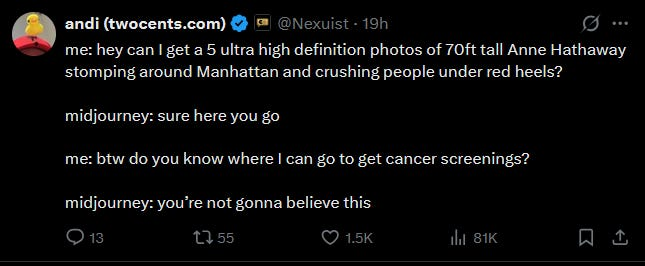
Here's the official announcement on their website, with a few videos:
https://www.midjourney.com/medical/blogpost
And I thought Scott Alexander's writeup was a good well-rounded perspective on the whole idea.
Society and culture
Parenting and loss of childhood autonomy
Duncan Sabien published a great piece arguing that the gradually tightening restrictions on autonomy and freedom of movement during childhood are causing immense harm while earning no positive gains in safety.
But I am so tired of politely pretending that they are not harming their kids. I’m so tired of validating their good intentions, and their limited resources, as they chain and confine their children, robbing them of their privacy, robbing them of their autonomy, inflicting upon them amounts of confinement that only barely fall short of the confinement we impose upon actual criminals, allegedly justified by an increase in safety that is not real.
And in an actually adequate world, they’d let their fucking kids have lives outside of their fascist panopticon. Life should not begin with an eighteen-year prison sentence, and parents should not be their children’s first abusers. Adulthood should not start with stumbling, blind and atrophied, into a world in which you have not ever been permitted to flex your muscles and try your hand.
Causes of the fertility crisis
Arnold Kling makes the case that the drop in marriage and fertility rates is primarily a result of the 60s/70s shift in social norms towards more permissive attitudes about premarital sex.
If the decline in fertility in recent decades is downstream of the decline in young people getting married, then I would argue that this is in turn downstream of the decline in the taboo against premarital sex. I think that matters more than the phones.
Mental Health
Don't worry be happy
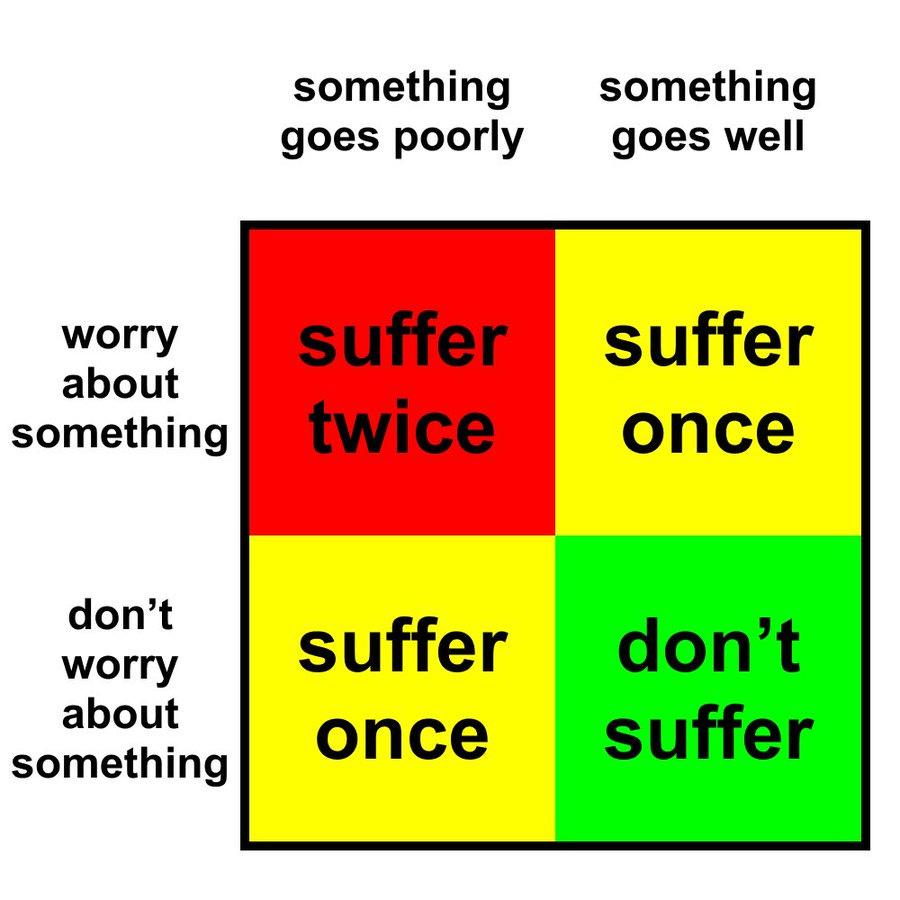
I encountered the below diagram via Zvi, and I like it a lot. I fully recognize that anxiety is not something that can be simply switched off, especially by those most afflicted with it. That said, to whatever extent your rational mind is able to overcome anxiety by recognizing that profuse worrying gains you little to nothing, it's certainly in your interest to minimize time and energy spent on worrying.
Pathologization of emotions
Also via Zvi, the below graphic:
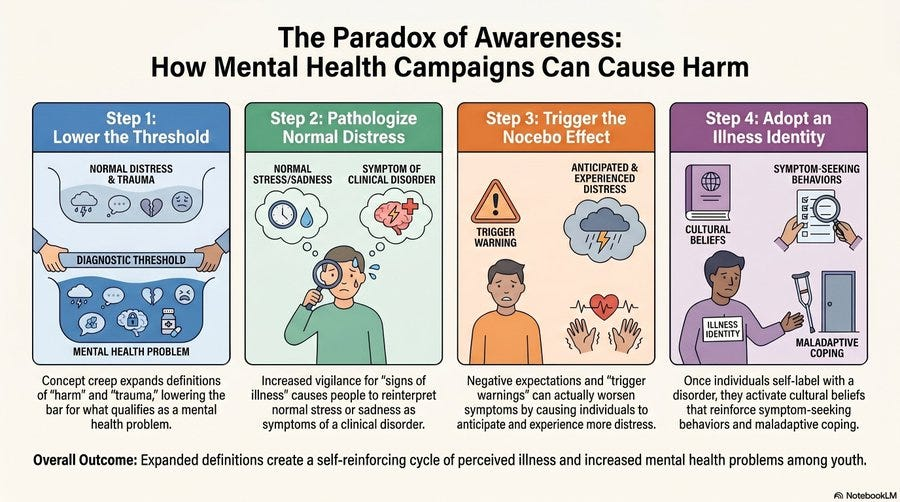
This points to a clear phenomenon which is very intuitively apparent to me, but is not evident to those ensnared in the "mental illness as a personality" vortex. I thought this graphic was a pretty decent encapsulation of the core ideas.
Miscellanea
Monuments in the desert
Why is Egypt paying China to build an isolated city called the New Administrative Capital in the middle of an empty desert?
Sisi wants to show he’s got big balls.
Egyptians have always liked to spend our money building great big things in the middle of nowhere.
I really enjoyed Nick Corvino's writeup about this in ChinaTalk. Includes lots of photos.
The priesthood of science
This guest post by a previous ACX grant recipient details the process and outcome of the grant project, demonstrating that a particular study's results do not replicate (unsurprisingly).
What resonated with me in this article was not the specifics of the experiment, but a passage near the end:
Science is currently a priesthood. A small class of experts has the time, resources, tools, technical fluency, and institutional permission to run a study — or to inspect the logic and machinery behind a published claim. The public is expected to stand outside the temple, read the final PDF, and trust the robes.
With this class rapidly disappearing, a new science might emerge. Your local blogger might have better meta-science skills than people doing science at top universities. An amateur with a laptop and an LLM can now do in a couple of weekends an investigation that used to take an expert a month.
If scientists won’t do their job properly, we can start doing it ourselves. The future of science may be more democratic than prestigious: less like priests handing down conclusions, more like a network of readers, analysts, critics, and builders continuously auditing one another’s claims.